Sunday, November 8, 2015

Yeah, It Still Feels Wrong

Yeah, I'm chipping in again.  Janelle has been bugging me to blog something for weeks (or months, I've lost track).  I've been busy with new hobbies though--I've published three new R packages in the past few months, am preparing a fourth, and have a cool new wood lathe that I love playing with (more on that another day).

But the events of this week in Mormondom were almost too big to let go.  I was ready to just let it pass, but I've come across too many statements from people frustrated by the many people they that are saying "I wasn't okay with the Church's new policies, either.  But then I prayed about it, and now I am.  Perhaps you should pray, too."

Well, guess what...I did.  I have.  And I still feel the same way I did when I prayed about this four years ago.  (yes, I was contemplating how we should respond to gay couples years ago.  Why are you all so late to this party?)  My conclusion: this policy stinks.  I'm not okay with it.

If you care to know why, here's what I wrote to a friend on Facebook about it

I think all this talk about the children is a side show. Let me rephrase the thing that really bothers me about this. Regardless of whatever kind of relationship a human being is living in, they are in need of Christ. Full stop.
That puts conservative religions in a tough spot, especially as the evidence builds that homosexuality has genetic causes. How do we bring gay men and women into the fold when their natural disposition is toward something we consider a sin? 
I can live with working with a gay person who is seeking the fellowship of Christ and saying that I don't understand how all of the complexities will work out in eternity. It's uncomfortable and deeply unsatisfying. But it's the reality of life.
If there is a gay person out there who is willing to tolerate all of those uncertainties, then we should throw open our arms to do everything we can to help them develop a relationship with Christ. 
This policy is a stiff arm. This policy sends the message that we don't even want to try. We don't care about a gay's relationship with Christ any more. Damn them all to hell!
That's why I hate this. And I'm ashamed of this church for doing it.
 Yes, I still feel that way.

For all of you people out there who agree with me, it's okay to feel that way.  I refer you to what I wrote in February of 2013. (http://myuncommondissent.blogspot.com/2013/02/i-tell-no-one-any-story-but-his-own.html).  Enough said.

For those of you who don't agree with me, that's fine too.  But before you start harping on me about following prophets and seeking confirmation from the Lord, and all that stuff you'll use to tell me that the only right conclusion is to agree with the Church, let me point out that our own scriptures establish a pattern of revelation.
Yea, behold, I will tell you in your mind and in your heart, by the Holy Ghost, which shall come upon you and which shall dwell in your heart.
 Now, behold, this is the spirit of revelation; behold, this is the spirit by which Moses brought the children of Israel through the Red Sea on dry ground.
As it turns out, in my mind and in my heart, I feel that this policy is wrong.  So bear with me while I hold confidence in what the Holy Ghost is revealing to me and I'll bear with you while you hold confidence in what the Holy Ghost is revealing to you.  Deal?  Good.  Done.

In the meantime, I'm not completely sure what the best way to invite gay families into our church is.  I'm not 100% sure my ideas would work.  It's a messy, complicated, challenging situation.  But I'm confident that we should be willing to work with any and all souls who wish to come to Christ, regardless of what their sins are.  Anything less is unbecoming of a disciple of Christ.

Tuesday, April 28, 2015

I Am Sad Today

It's a beautiful day in Kentucky. The Sun has been out and the landscape is lush and green. I managed to successfully organize all of my documentation for work today in a new R package that should make a very smooth process for compiling our required reports. And I got to run around the back yard with the girls and play board games with Julie. It really seems like the perfect day.

But I am sad.

I am sad because I looked at my Facebook feed and saw friend after friend celebrating a woman giving her son a beating when she found him participating in the Baltimore riots.

I suspect this will irritate some of my favorite characters, but why the hell are we celebrating this?

I get that we are tired of riots. I understand the calls for peaceful protests. But the stench of hypocrisy is overwhelming when we condemn violence by those with whom we disagree but celebrate it by those with whom we agree.

There are serious social issues coming to head, and instead of listening to each other, we're looking for self validation. Aren't we just all so wonderful!

So let's set the record straight right now. Violence is wrong. Full stop.

Even when it is justified, it is wrong.

Even when it is necessary, it is wrong.

Even when it is unavoidable, it is wrong.

Violence of all forms invariably harms the bodies, minds, and souls of both the attacked and the attacker.  And when we participate in the celebration of violence, we do damage to our own souls.

Please, let's stop this.

Sunday, March 8, 2015

We Must Not Pull Up the Tares

The kingdom of heaven is likened unto a man which sowed good seed in his field:
But while men slept, his enemy came and sowed tares among the wheat, and went his way.
But when the blade was sprung up, and brought forth fruit, then appeared the tares also. 
So the servants of the householder came and said unto him, Sir, didst not thou sow good seed in thy field? from whence then hath it tares? 
He said unto them, An enemy hath done this. The servants said unto him, Wilt thou then that we go and gather them up? 
But he said, Nay; lest while ye gather up the tares, ye root up also the wheat with them. 
Let both grow together until the harvest: and in the time of harvest I will say to the reapers, Gather ye together first the tares, and bind them in bundles to burn them: but gather the wheat into my barn. (Matt. 13:24-30).

Jesus was a story teller.

For practically two millenia, people have been mining his stories for deep, hidden truths.  His parables are known throughout much of the world and are the focus of books, articles, web pages, and sermons.

There is both beauty and frustration in Jesus' stories, because his stories are typically classified as parables.  Unlike the parable's cousin the allegory--for which the correct interpretation is generally believed to be the author's intended interpretation--the parable can mean different things to different people.  For that matter, a parable may mean different things to the same person at different times.  Parables are, by their nature, vague and polymorphous.  Like Play-Doh, a parable can be shaped to fit the needs of a situation or of a particular person.

The Parable of the Wheat and the Tares, which I read earlier, is the second of seven parables given in that chapter.  And those seven parables definitely had a theme.  The Wheat and the Tares is the first of six parables to be prefaced with the words "the kingdom of heaven is like unto."

Something unique about this parable is that it is one of few parables that Christ interpreted for us.  So, we could make this a really short talk and just read Christ's interpretation.  The wheat are the righteous and will be saved; the tares are the wicked and will be burned, yadda yadda yadda...but how boring.  So I'm going to argue that at best, this interpretation is useless; and at worst, it is wrong.

The 'at best' qualification involves interpreting the parable at a general level.  Although Christ eventually gave the interpretation, he only gave the interpretation to his closest associates.  We understand that, at the time, there were a number of Jews looking for a savior to redeem Israel from Roman rule.  They wanted a savior that would release them from political bondage and restore Israel as a political force in the region.  For them, the parable of the wheat and tares would have been an early introduction to the idea that perhaps there wouldn't be a political savior; and that the Kingdom of God could still thrive under foreign rule.  To His closest associates, the parable may have been an early introduction to the idea that the Gospel would be taken to all people, not just those of Abraham's lineage.

This general level interpretation isn't very useful to us.  We as a church, and Christianity as a whole came to terms with this interpretation nearly two thousand years ago.

The 'at worst' interpretation involves assuming that each person in the world is either a wheat or a tare.  And this, I believe, is a flawed and dangerous interpretation.  It runs contrary to many of Christ's other teachings. And based on the fact that this and several other parables were prefaced with "the kingdom of heaven is like unto," I don't think Christ ever thought of individuals as either wheat or tare.

The problem with that interpretation is it assumes that some people were wicked the moment they were born into the world.  We know this isn't true: "For behold, the Spirit of Christ is given to every man, that he may know good from evil" (Moroni 7:16).

This interpretation also bars the possibility of change.  But Nephi tells us, "I know that if ye shall follow the Son, with full purpose of heart, acting no hypocrisy and no deception before God, but with real intent, repenting of your sins, witnessing unto the Father that ye are willing to take upon you the name of Christ...He that endureth to the end, the same shall be saved" (2 Nephi 31:13, 15).

It's time we moved past the wicked/righteous dichotomy.

Now, if the kingdom level interpretation is useless to us, and the individual level interpretation is wrong, we need a new interpretation.  We need an interpretation that fits our needs, our culture, our unique challenges.

Fortunately, Christ offered us some insight into how we might reinterpret the parable.  A woman was brought before him, and her accusers challenged Christ to make good on his parable.  "Destroy this tare," they dared him.  The woman caught in adultery was thrust before him and they asked if she should be stoned.

After a brief moment of quiet contemplation, he dispelled her accusers.  "He that is without sin among you, let him first cast a stone at her."  As the accusers dispersed, hopefully having seen a bigger picture, Christ turned to the woman and comforted her.  "I do not condemn you," he said.  "Go, and cultivate your wheat."

The power that comes from our parable is not in seeing individuals as a single wheat or a single tare, but in seeing each individual as a field full of both wheat and tares.  We are each rich, fertile soil full of both of right and wrong choices; of good and bad ideas.

I learned a valuable interpretation of the wheat and the tares a few years ago when I was attending the sealing of my best friend.  It is one of only a few opportunities I've had to see two people sealed to each other in the temple.  We were ushered into the sealing room, my friend and her husband came in after and before the ordinance, the man performing the sealing spoke to them.  For ten minutes, he spoke to the groom about his responsibility to protect, provide for, uplift and teach Marie and their future family.  And then he turned to Marie and said, "All that applies to you too."

I. was. livid.  Livid isn't a strong enough word, but I do believe we're discouraged from using the language that would accurately describe how I felt at the time.  Marie had served a mission, earned a doctorate degree, was brilliant, accomplished, generous.  And in what is said to be one of the most exquisite moments of our lives, she got six words for no reason other than she was the wife.

Yeah, I was livid.

So after the sealing--and a few (or 30) minutes outside in the parking lot to calm down--I went back into the temple to do an endowment session.  In the presentation of the endowment, the creation of the world is presented and some of God's rationale behind His creations are stated.  And at one point that day (and I admit, I might have still been brooding over the sealing), I remember the Spirit slapping me in the back of the head and saying, "Hey, pay attention here.  You're about to learn something."  And that was when the narrative explained that the earth would be created with mountains, hills, valleys, rivers, and streams, "that there may be beauty and variety on the face of the earth."

In that moment, I was taught that people have different ideas.  People have different beliefs.  People have different interpretations.  And all of that diversity gives beauty to our church.  All of that diversity gives beauty to the kingdom of heaven.

I've spent the years following that experience trying to learn more tolerance and appreciation for ideas and opinions that differ from my own.  I'm usually wildly unsuccessful, but I'm trying.

And I don't mean to say that all ideas are good.  Certainly, I think there are a lot of bad ideas out there.  If you talk to me for any length of time, you'll hear a lot of griping about politics, the Church, and people in general.  Some of my thoughts are wheat, some are tares.  And some of those things I gripe about are wheat, and some are tares.

Now here's the really, really hard part.  We must not pull up the tares.  Remember, the kingdom of heaven is like unto a field of wheat and tares.  Our task is to build the kingdom of heaven.  But when we engage in crusades to root out disagreement and dissent, we root out the wheat as well.  And keep in mind, sometimes the disagreement and the dissent are the wheat.

Our task is to build the kingdom of heaven.  That means studying both the wheat and the tares.  That means we need to be more open about our thoughts, beliefs, and experiences, as well as more sensitive about how we present them.  We need to speak with the intent of building the kingdom of heaven.

For the past several years, I've taken to observing Lent.  Lent is a traditional Christian period of fasting that lasts 40 days leading up to Easter.  In one of my first years observing Lent, another Mormon, apparently bothered by my observance, made a snarky remark about how Mormons do it better because we fast all year round, not just one time a year.  This person was then bothered that I defended the practice.  Keep in mind, Mormons may fast throughout the year, but as an organization, we fast for twelve days a year, less than a third of the time of Lent.  But to this person, it seems that Lent wasn't 'Mormon enough,' and so I was in need of correction.

What's important to recognize, though, is that there is value in both of those traditions.  The Mormon fast has applications in charity and sacrifice as it is tied to fast offerings.  The Christian Lent has applications in self improvement, as forty days of giving up something is long enough to establish a habit.  Sure, both traditions have their weaknesses, but both traditions also have their value.  We should look to identify the wheat in both of them, and cultivate those aspects.  And rejecting one because it isn't 'Mormon enough' does nothing to build the kingdom of heaven.

On the other hand, when I say things like, "I don't like Mormons enough to vote for one to be president" -- yes, I really said that.  And I regret it, because even though it may bear some resemblance to how I might actually feel, the way I said it is divisive and hurtful.  It does nothing to build the kingdom.  We desperately need to stop doing these kinds of things to each other.

Instead, we need to see that even when we may disagree about how to build the kingdom, we are all committed to building it together.

So, there it is.  We need more kingdom building.  We need more debate with friendship.  We need more discussion with less preaching.  We need more disagreement with laughter.  We need more time together.  We need more compassion.  We need more empathy.

In the name of Jesus Christ, I declare that I am convinced that this is the Kingdom of God.  As frustrating, backwards, and unpleasant as I sometimes feel it is, I am still convinced that we are building God's Kingdom--that we are all building God's Kingdom.  And I believe that the authority and the keys to bring individuals to exaltation lives here.

So here is the challenge I leave for all of you (and all of me).  Let she who is a field of pure wheat pull the first tare.  Otherwise, go.  Cultivate your wheat.  Build the Kingdom of God--do extraordinary things; think extraordinary thoughts; build extraordinary friendships--that there may be beauty and variety on the face of the earth.  Amen.

Tuesday, December 16, 2014

Advent and Anticipation: Hastening the Lord's Return

I had a plan.  It was a good plan, too.  This would be a Christmas celebration for my congregation like we'd never had.  We've still never had it.

When I was asked to plan our ward's Christmas party, I had this crazy idea to extend the celebrations beyond just one single night.  Why not celebrate for a whole month!?  And so I read about Advent and concocted an idea of how to implement the season into our worship and our celebrations in a way that was consistent with Mormon meeting schedules. I chose readings from the liturgical calendar that adapted well into Sacrament meeting talks.  I suggested that we invite the members of the congregation to come to church dressed in traditional colors (purple, blue, red, and gold) to build a sense of unity and anticipation.  We would focus on the expectation of the arrival of our Savior, think on what His arrival meant to us collectively and individually, and look forward to His return.

In a stunning irony, the plan was shut down because, apparently, asking men to wear colored shirts to church is "too traditional1."

Coming up with the idea has been hugely beneficial to me personally, however.  I got to ponder the following scriptures in the context of the coming of the Savior:


  • Isaiah 64:19
  • Psalm 80:1-7, 16-18
  • 1 Corinthians 1:3-9
  • Isaiah 40:1-11
  • Psalm 85:12, 8-13
  • 2 Peter 3:8-15
  • Isaiah 61:1-4, 8-11
  • Psalm 126
  • John 1:6-8, 19-28
  • Luke 1:26-38


This Advent focus on Christmas has really enriched my understanding of the Christmas season. Advent is a time of anticipation. It's a time where we can put ourselves in the mindset of those who were waiting for the Savior to come; of those who were looking forward to being saved. And I was able to ask, "what do I expect he will save me from?"  

As I thought about this question, and I'm still not sure I have a good answer to it, I ran into a few conversations that discussed the state of "the World2." More specifically, about how the world was going to hell in a handbasket and that we would need Christ to return to earth to save us from all this wickedness. "We are seeing the signs of the times!" goes the refrain. The phrase that hit me like a ton of bricks was "[in that day] the love of men shall wax cold" (D&C 45:27).

What really struck me, though, were the examples that were cast about as illustrations of the World's wicked state.

President Obama's executive action on immigration, for instance, was used as an example. Apparently, we need Christ to come redeem the earth from the tyrannical impact of immigration reform. The outrage seemed to be split between the gall of the executive action itself and the idea of permitting anyone a path to citizenship after coming illegally3. And as I listened to these comments, I couldn't help but notice just how wrong-headed Americans (Mormons and non-Mormon alike) are about this issue. For the die hard conservatives, let me just point out that building a wall and mass deportation are idiotic ideas. For the die hard liberals, let me point out the all-out amnesty is an idiotic idea. In fact, every immigration reform idea I've heard in the past year is idiotic. Because not one of them deals with the problem.

We talk about immigration like it's a burden on us poor, victimized Americans. Many in the church talk about the imperative to obey, honor, and sustain the law (Article of Faith 12). I agree that we should obey the law. But when push comes to shove, there is no wall I won't scale, no border I won't cross, and no law I won't break if it means feeding and clothing my children. I'd go to hell and back--or even just take the one way train to hell--to prevent their suffering. Why would I expect Central and South Americans to behave any differently?


That is to say that our immigration problem doesn't reside in the US. It resides in poverty and corruption stricken countries. It resides in those areas of the world where there is so little hope and opportunity, that people will risk everything to escape to the US where they might live "comfortably" on a minimum wage (or less) job. The solution to our immigration problem isn't more bureaucracy; it's relief from poverty. But we seem to be too self-absorbed in "American Exceptionalism4" to grasp that.

In that day, the love of men shall wax cold.


In the past weeks, I've listened to a number of Mormons complain about the racial divisions being promoted by those protesting the results of the Michael Brown and Eric Garner deaths. "These people were criminals!" they say, and it is a vindictive racial political machine that is turning this into an issue for the sake of money and power. Some of that may be true. Objectively speaking, in the case of Michael Brown, perhaps he wasn't the best poster child for racial tensions in the USA. But it's an incredible leap of hubris to say that there aren't deeply seated racial issues at play here. And it takes either ignorance or malice to claim that the rage that is boiling over is the result of pure opportunistic money grabbing and not decades of abuses and frustrations.

I live in a ward with African American members who personally witnessed crosses burning and klansmen riding. They remember the fear and intimidation that was used as a weapon to gain their submission, and they remember the government and law enforcement institutions that looked the other way. This is recent history! and the scars have not had time to heal, nor have the after effects been resolved. But we seem to be too self-absorbed in our post-racial America to believe it.

In that day, the love of men shall wax cold.

Over the years I've been in my congregation, I can't remember how many times I've heard someone say, "I can't wait until the day that we have a temple in Kirtland." Kirtland, for those of you who aren't familiar with the geography of northeast Ohio, is about a 30 minute drive out of the city of Cleveland. It is an affluent city with no major public transportation lines. A temple in that area would be great...for people with cars; for people with good, stable jobs; for people with money. A temple in Kirtland is no more accessible to the poor and those desperately in need of the Temple's blessings than the temple in Columbus (2.5 hours drive away). But a temple on a major public transportation line in Cleveland would be too ugly a location in "a bad neighborhood." It would be beneath the sensibilities of the privileged, affluent Mormon to go to such a location to worship.

In that day, the love of men shall wax cold.

And now, all of a sudden, I'm wondering if we have this whole Second Coming thing right. I'm pretty sure we don't, as a matter of fact. Sure, I have no doubt that "the World" could turn so wicked that Christ has to come back to save us from tearing the Earth to pieces. But I don't think that will be a happy day.

As I've pondered the arrival of the Savior this Advent, I've made the connection that so many people at the time were looking forward to the Savior's arrival to rescue them from political entrapment; to save them from the Romans; to establish them as a free nation again. They were looking for a Savior to save them from "The World."

But Christ didn't save them from the World. Christ chastised the religious developments and the zealotry. He completely upended the religious institution. He effectively said, "You screwed up my Church, and I'm here to fix it."

If the world gets so bad that Christ has to come back to save us from it, I expect he'll greet us with the loving chastisement of, "Wow, you guys really screwed this up."

But I think there's another way. I'm not convinced any longer that the World devolving into wickedness is a prophecy that must come true. Instead, we were given the promise that if it did come to that, Christ would rescue us. But I don't believe that he has to rescue us.

What if we could change the story? Could we take seriously the words of Isaiah:
Thou meetest him that rejoiceth and worketh righteousness, those that remember thee in thy ways (Isaiah 64:5)
What if we were to change the way we think, and how we approach our problems?  What if we were to try to think outside ourselves more and develop the kind of knowledge and understanding of each other that would build bridges and solve difficult problems?

I believe that we could build a world that is so righteous that Christ will return not to save us from wickedness, but to celebrate our righteousness.  I believe that we can build a world that would be so pleasing to the Savior that he would meet us and celebrate with us.

But to do so, we have to stop looking to be saved from the external. We have to stop seeing the problem as The World and start seeing the problem as Ourselves.   We must not let our love wax cold, but set it afire with the flames of empathy, compassion, and cooperation.

I posed the question earlier, "what do I want the Savior to save me from?"  And I said earlier that I didn't quite know how to answer that.  I think now I do.  I want the Savior to rescue me from selfishness, from greed, and from my own predjudices.  And it's a good thing we believe in an infinite Atonement, because it might take every bit of infinity for the Savior to rescue me from myself.


1 There is a long cultural tradition of men wearing white shirts to church, much like Mormon missionaries. This tradition is so engrained that some call the white shirt, tie, and suit coat the "uniform of the priesthood." (gag)
2 For Mormons, the World is pretty much anything not Mormon and is typically used as a pseudonym for anything perceived to be uninspired or ungodly. Like celebrating Advent.
3 The Church's official stance on immigration policy is actually quite moderate and admirable. But it's a position that seems to be lost on many individual Mormons.
4 If ever I've heard a vomit inducing phrase, that would be it. How about "Human exceptionalism?" But even that is sullied by human depravity. But I digress.

Wednesday, November 26, 2014

The First Time in Ten Years

Playing football on Thanksgiving morning is a tradition I've enjoyed every year since 2003. No matter where I've been, I have sought out or organized a football game. I have played in rain, snow, mud, and ice. Every time I've come home with a massive headache, extreme soreness, and fatigued enough to require a nap.  I've loved it (although Janelle is generally less enthused by the time I spend napping instead of helping prepare the house for company).

It won't happen this year, though. My streak is over.  There is a game happening. I just won't go.

I'm not going because the email invitation sent to my congregation's men's group read, "Be there... or consider attending the relief society [the women's group] next Sunday."

I'm not going because the use of this stereotype is inappropriate and offensive.

Don't get me wrong--my feelings aren't particularly hurt. I'm not having a tantrum about this. But I don't feel it would be right to quietly boycott the game.

So let me tell you a little about me and explain how I came to learn why this stereotype is offensive.

I have a long history of making sexist jokes. It's a miracle my high school advisor never slapped me. I used to making all sorts of chauvinist remarks just to get a reaction out of her. Ms. Stanton was wise enough never to give me a reaction and I justified my attempts at humor by saying that it was obvious I didn't believe what I was saying.

Part of me wishes Ms Stanton had called me on it and taught me why I was in the wrong (the other part if me thinks she might have known me well enough to know that I was too arrogant to be taught at the time). But what I did was shameful, because I was inflicting pain on someone for my own enjoyment.  Even if she knew that I didn't believe what I was saying, it is wrong to toy with someone's emotions like that. It is wholly inexcusable.

I see the same action in the wording of the football invitation; I don't believe there is any malice behind the joke. I don't believe that the person who said it believes the stereotype.  And that's precisely why we need to stop using these stereotypes as comic material.

It is never funny to imply that women are frail just because they are women. It is never funny to imply that men aren't tough because they don't desire to participate in a ritual of aggression or competition.  It is never amusing to suggest that any person should participate in any activity for any reason other than they want to, are interested, and their company is desirable.

And if we don't believe these stereotypes that we use for humor, then it is imperative that we stop perpetuating them. Stereotypes will never, ever die so long as we continue to repeat them. This is true regardless of what we believe about their validity.

So for the live of all that is holy, stop repeating them. Stop thinking them. Stop laughing about them.

And for the record, even if I did play football tomorrow, I would love to attend the women's meeting on Sunday. Show me a men's group that is more friendly to sharing our deepest emotions; show me a men's group that will cry with me, laugh with me, hear my goals and ambitions, and stand by me even in disagreement; show me a men's group that is a little more like the women's groups you mock and dammit! That's the men's group I want to attend.

So, I will proudly say that I will not be playing football with my men's group tomorrow. I'll stay home and do something that doesn't imply any person should fit into any box not of their choosing.

And if there are any women reading this who enjoy playing football, please go to Laurel School on Thanksgiving at 8:30 AM and knock a few guys on their asses.  And if they say anything about playing soft against the woman, knock them on their asses again. Keep doing it until they knock you on your ass. Maybe then they'll start to understand.

Monday, October 27, 2014

Those Things I Don't Believe

As you may have noticed, I'm an evidence-based kind of guy. I like data, and I like a well reasoned and justifiable logic. This is certainly influenced by my professional career, but I like to think that it confirms well to the whole gentleness, meekness, and persuasion thing (would you like fries with your justification?)

One of the benefits of being so evidence-based is that it is relatively easy for me to realign my beliefs when presented with new and better evidence (the 'better' qualification is a crucial element).  If you provide me with better evidence, I'll respond with better beliefs. 

It was the process of gaining more evidence that led me to abandon my belief in a worldwide flood. There were just too many holes in the story. Too many reasons it couldn't be true and not enough reasons it could. I found that as I asked questions about the flood--how could there be enough water to 'baptize the earth?'; wouldn't the elevation change cause asphyxiation?--the apologists' answers became more and more implausible.

Evolution was another issue that gradually grew on me.  First, I was a pure creationist, then I bought into the six creative periods. Next it was some conglomeration of creationism and evolution (probably not unlike Intelligent Design) and finally settled on evolution. At  this point, I'm a fairly strict evolutionist. 

The implications of these modified beliefs are, I imagine, exactly like what strict biblical interpretationists feared about evolution. Evolution has crushed my confidence in certain beliefs that are widely accepted as simple fact in orthodox Christianity and/or Mormonism.

Let me list a few. 

First, I don't believe Adam and Eve actually existed. At least not as we envision them in our canon. I don't believe in the first-humans-ever-and-distinct-parents-of-the-human-race mythology.  Rather, I suspect the man we know as Adam was the first man God chose to be a prophet. And he was likely chosen at a time when God observed the evolution of a species capable of the moral reasoning on which agency is based.

Things snowball from there. Reject the Adam-as-first-man philosophy brings into question numerous other beliefs. And so I find it unlikely that Eve was formed from a rib; or that the Garden of Eden was on the American continent (or that it even existed, for that matter).

It seems so much more plausible to me that Adam and Eve were the first leaders chosen to establish gospel teaching. That they did so at the very earliest stages of Humanity's development, and that the Flood was a literary device to bridge the gap between oral and written history. It seems more plausible that Moses (and the actual biblical authors) used the common creation myths of the day to convey eternal principles.

This has added a subtle new dimension to how I think about some things. Not too long ago, I came across an online discussion about Eve's motivations for taking the fruit of the Tree of Knowledge. I can't really comment on Eve's motivations because I don't believe there was an actual Tree or actual Fruit. I think the more relevant question is, what were the motivations of the person who wrote the allegory in designating Eve as the first to partake? (And that is a separate entry entirely).

I suspect that I will get a certain amount of pushback about rejecting the Adam and Eve story. The Creation, the Fall, and the Atonement are crucial aspects of the Mormon narrative. I suppose the argument goes that if there is no Adam and Eve, the there is no Fall. And if there is no Fall, there is no Atonement. But I don't think that's true.  If the Creation story of Genesis is an allegory--a teaching device--and we acknowledge a loss of information between oral and written histories, then it seems perfectly plausible to conclude that the Fall--being the representation of when Man became accountable for their sins--happened in some other and probably boring way (the same boring way children become accountable?)

It's also possible I'm completely wrong about all of this. Which is fine. I don't particularly care if Adam and Eve were a real thing or not (so why write all this, you ask?  I was bored and cranky).

So let me wrap up with those things I do believe.  I believe that God recognized that we wouldn't be able to live up to His strict and perfect expectations.  I believe that God had the wisdom to comprehend the competing needs of justice and mercy.  And I believe, in His eternal pragmatism, He provided a Savior that could balance those competing needs.  Most importantly, I believe that even with zero understanding of how God established His presence among humanity, those things I do believe are far more valuable than those things I don't.

Wednesday, July 2, 2014

Christ Becomes Real

Would you believe me if I told you I used to be an opinionated jack-ass?  Well, you shouldn't--the tense of that sentence is wrong.  I'm still an opinionated jack-ass.  Fortunately, I'm not quite as extreme as I used to be.

In one particularly egregious example of jack-assery, I got into an argument with someone about the appropriateness of including Santa Claus in ward Christmas parties.  I was adamant that Santa Claus had no business having any mention in the church, as we should be teaching people, especially children, about Christ.  Fantasy and mythology need not apply.  My inflexibility on the subject leaves me a bit embarrassed.  I certainly could be an idiot when I was younger.  As I've learned more about how children's I've come to understand that to young children, when we talk of Christ, he is every bit as real as Santa Claus.  At the same time, to a young child, Christ is every bit as mythical as Santa Claus. By the time children develop the cognitive ability to distinguish between fiction and history, it really doesn't matter what they've learned about Christ and Santa Claus.

Realistically, all children will eventually learn that Santa Claus is fiction.  Christ will suffer the same fate unless the child feels the Holy Spirit confirm the reality of Christ to them.  Currently, my opinion on Santa Claus at ward parties has evolved.  Just have fun and spread joy.

Joy is a good word for what I've felt much of the past week.  My family has been on a cross country road trip from Cleveland to Los Angeles.  We've taken a rather indirect route, visiting family and friends along Interstates 80 and 70.  I can't begin to explain how much I've loved watching my daughters play together; support each other in those awful long days in the car; sing songs together; and giggle with delight on the Tram up a mountain.  This trip has been 100 times more fun than I anticipated.

As we talked to our daughters about the places we would see, Bug said that she wanted to stop in Salt Lake City to see Temple Square.  She has a familiarity with pictures of the Salt Lake temple and was curious to see the building that is in so many of the pictures she has seen at church (I guess).

It didn't really hold her interest.  By the time we made it to Temple Square, she was more interested in running up and down the sidewalks, admiring the flowers, and trying to play in the fountains.  Pretty much anything we showed her would hold her interest only briefly.  Invariably, she would take off running and giggling.

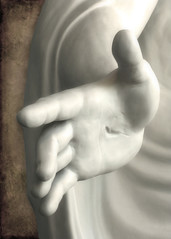
To finish our visit to the Square, we stopped in to see the Christus statue.  The physical design of this exhibit is brilliant, as you are able to walk up a spiral ramp to the viewing area.  The statue kind of pops into view and leaves quite an impression.

Bug was particularly struck by this statue, and she positioned herself about 5 feet away from the pedestal, looked up, and was positively glued for a minute.  Then she did something that really stood out to me.  I watched as she lifted her arms to 90 degree angles.  She turned her palms up, tilted her head down, and examined her hands.  First her left, then her right.  Slowly and deliberately, she looked up again at the statue.  She studied Christ's hands carefully, comparing them with hers.  Christ's hands had strange holes that her hands didn't.  It was a difference that captivated her.


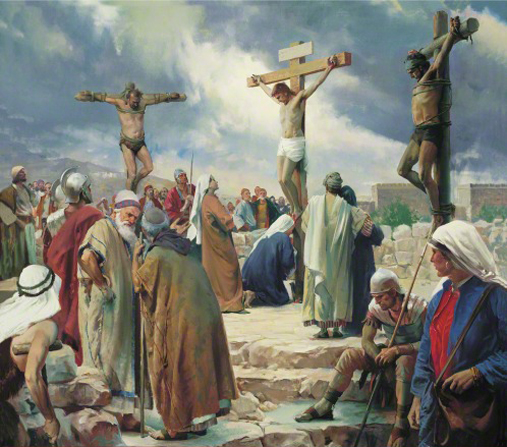
After a couple minutes, she stepped away, and we made our way back downstairs.  The downstairs portion of the exhibit displayed several large paintings depicting Christ's life and ministry.  I took Bug's hand and walked her over to one painting of Christ hanging on the cross.


"What do you notice about His hands?" I asked her.

"They're bleeding."

We talked about how people drove nails through his hands to hold him on the cross1.  We discussed the significance of Christ retaining those scars after his Resurrection to remind us of how he suffered so that we could return to God.

Bug is normally very sensitive to discussions about people suffering.  She usually withdraws from such conversations.  She worries about people who suffer and her sadness is visible in her eyes.  I saw a flash of that withdrawal for a moment at the start of our discussion.  But it was only a flash.  Then I watched as truth infiltrated her soul.  I watched the Holy Spirit reach out to her.  Right then, I saw Christ became more real than Santa Claus.  For the first time, Christ became real to her.  And with her help, once more Christ became real to me.

Bug turned to the podium in front of the painting.  "What does this say?" she asked.  I read:
he was wounded for our transgressions, he was bruised for our iniquities: the chastisement of our peace was upon him; and with his stripes we are healed. (Isaiah 53:5)
"With his wounds, we are healed." I explained to her, fighting back tears.  She wrapped her arms around my neck, and I could have lived in that moment forever.

"Daddy?"

"Yes, Bug?"  I looked her in the eye, ready for the profound truth about to come from the mouth of my babe.

"I need to go potty."

1 "Because they ran out of rope" she said. (the thieves are tied up with ropes in this painting)

Thursday, June 12, 2014

A Little Less Like Home

The past 24 hours have been an arrangement of sadness, laughter, and joy.  I have to thank the friends who helped bring in the laughter and joy.  Without their company, I might have spiraled into an all-out rage.

Two members of the Church are being called to a disciplinary council.  These councils are the formal mechanism by which members may be disfellowshipped or excommunicated from the church.

I get that the Church has the right to do this.  I understand why they are doing it.  But in the larger context of the past few weeks, it makes me very uncomfortable.  For me, this is what I see coming from the Church right now:

  1. We're meeting with Mormon Women Stand because this is how we feel proper women of the Church should behave.
  2. We don't meet with extreme groups.  If you have questions about the role of women (or other teachings of the Church), meet with your local priesthood leaders.
  3. By the way, we're likely excommunicating a few of people who have been critical of Church teachings.
So yeah, I feel real comfortable talking to my bishop now.

The thing that I find most frustrating is that it feels like the Church hasn't even attempted any real dialog on the issue.  The closest thing we've seen is Elder Oaks' talk in the most recent General Conference.  I read his talk again this morning to see if there was anything I missed.  Let me share with you all of the new things I learned from his talk-----okay I'm done.  Because he didn't teach anything new.  

Maybe I'm exceptional (I doubt that), but I already knew everything he talked about.  Reminders are great.  I won't begrudge anyone a reminder of the Church's position.  But reiterating your position is not the same as having a dialog on the topic.

For clarity's sake, let me mock up the conversation as it appears to have been had from my perspective:
Ordain Women: We believe true equality requires that women be ordained to the priesthood.
LDS Church: We disagree with your conclusion.
Ordain Women: Perhaps we should talk about this.  Here's are the assumptions and logical processes that led to our conclusion.
LDS Church: We still disagree with your conclusion.  
Ordain Women: Could you elaborate on your assumptions, or tell us where you disagree with our assumptions?
LDS Church: We continue to disagree with your conclusion.  We will now restate our conclusion.   
 Yes, there's a lot of nuance missing there.  There's a lot more going into the disciplinary councils than just pressure for dialog.  But this is the core of what bothers me about the whole affair.  I am extremely uncomfortable with the Church leadership stating its conclusion without explaining how it got to the conclusion.  Would it really be so hard to say something as simple as "We disagree with your assertion that Joseph Smith ordained Emma Smith to the priesthood--it is our understanding that the language surrounding priesthood ordinations and settings apart was not as specific as it is today.  We believe that, in modern language, Emma Smith was set apart to a position of authority."

I want to understand.  I don't even have to agree with all of the logic in order to accept the result.  I just want to see if the logic that led to the result is internally consistent.  With the information that is coming out of the Church (and by information, I mean deafening silence), I can't do that.

I keep hearing people say, "Well how do you know that they haven't prayed about and gotten an answer."  I don't.  I also don't know that they have prayed about it.  I don't know anything.  I haven't been given the chance to understand.  Everything I've heard is just a reiteration of what the current position is.  And that's precisely what bothers me.

Today, I feel a little less safe in the Church.  I feel that people like me, who want more depth and understanding--about not just what, but why and how--are less welcome.  I feel I've lost a part of the refuge that church has been for me the past six months.  Church feels less like home today, and that makes me sad.

Friday, June 6, 2014

Mormon Superiority Myths: Infidelity

I'm a sucker for click-bait, I'll admit it.  But my fascination usually stems from a curiosity regarding how badly the headline mangles reality.  So I couldn't resist when I saw the headline "You May Be Surprised How Many Born-Again Christians Use Ashley Madison."

A new survey conducted by Ashley Madison -- a dating website for people already in relationships -- sought to discover the link between religion and infidelity by asking 105,000 of its members around the world about their religious affiliation. More than 60,000 of the respondents were in the U.S.

The implication is that Born-again Christians are more likely to cheat on their partners than those from other religions because they make up 25.1% of the user base at Ashley Madison.  Don't be fooled: they have demonstrated no such thing.  Instead of demonstrating that a randomly chosen Evangelical Christian is more likely to be a user of Ashley Madison, they've actually shown that a randomly chosen Ashley Madison is most likely to be an Evangelical Christian.

Big deal.

If we take a look at the percentages of religions in the population compared to the percentages of religions in the user base, we get a different idea.  Take a look:


Religion Percentage of Population Percentage of Ashley Madison Users
Evangelist 26.3 25.10
Catholic 23.9 22.75
Protestant 18.1 22.70
Agnostic 2.4 2.00
Mormon 1.7 1.60
Muslim 0.6 1.50
Jewish 1.7 1.40
Atheist 1.6 1.40
Jehovah's Witness 0.7 0.50
Hinduism 0.4 0.30


As you can see, the percentages track pretty well.  Statistically, we would call this good agreement between the data.  A goodness of fit tests also indicates no reason to suspect that the distributions differ (p = 0.22).

What's the practical interpretation?  Effectively, all American religions (and non religions) suffer from infidelity in fairly equal proportions.  Well, at least the kind of infidelity where people are willing to pay a website to help them cheat.

So what does this all mean for Mormon culture?  Nothing really.  At most, we might think that Mormons aren't any better behaved than other religions. 

My advice: save your money and take your partner out to dinner.

http://religions.pewforum.org/affiliations
http://religions.pewforum.org/reports
http://www.huffingtonpost.com/2014/06/04/infidelity-and-religion_n_5447526.html?tm_hp_ref=mostpopular

Friday, May 30, 2014

On Missing Context

The Church's public affairs department sent an open letter to mormon blogs yesterday.  You can read it for yourself.  There are parts of it I like, and parts of it I don't.

First, the part that I don't like.  Otterson describes a criticism from the internet community at "By not engaging with the more extreme groups, the Church – and Public Affairs in particular – is not acting as Christ would."  Let me start of by just clarifying that the argument "public affairs is not acting as Christ would" is just stupid.  I get that much.  Public affairs is an entity meant to help develop and distribute messaging from the Church.  They shouldn't be expected to "act as Christ would."

That being said, if you're going to claim that you're not meeting with extreme groups, then don't meet with extreme groups.  And yes, Mormon Women Stand is an extreme group.  In response to Ordain Women, they describe themselves as women who "unequivocally sustain the First Presidency and Quorum of the Twelve Apostles."  That may seem perfectly harmless at first, but unequivocal doesn't leave much space for doubt and concern.  The expectation of unequivocal stifles innovation and creativity in solving problems the Church and local congregations face.

Mormon Women Stand and Ordain Women are the opposite extremes in the discussion of women's issues in the Church.  So let's not claim that we're not meeting with extreme groups.

The part I did like: in response to the question of whether women (or men) are ever demeaned or marginalized in the Church, "Yes, of course....What this argues for is better training of leaders and members1."  As it turns out, I just had a brief talk with my bishop about this on Tuesday.  And I can't tell you how relieving it is to have a bishop to whom I can speak of my wholly equivocal support for how the ward is being managed without him calling into question my commitment to the Church.  But we talked about how so many positions in the Church require strong leadership skills, and the Church does next to nothing to teach those skills.  I mean that quite seriously: the Church does next to nothing to teach its members leadership skills.

Sure, we have "leadership training" meetings pretty much every stake conference.  There's one catch to those training meetings, though--you're only invited if you've already been called into leadership.  And most of the leadership training meetings I've been to end up with a public speaking format (ie, usually no interaction between the speaker and the audience) and focus on how we need to "listen to the Spirit" and "ask for and follow inspiration."

I won't argue against those principles.  They are certainly true and valuable.  But how about doing workshops that teach interviewing skills?  How about workshops that teach leaders how to ask questions that get members to evaluate and express their own beliefs?  How about workshops that teach leaders how to build a common vision and inspire people to want to contribute; to do better than manipulate them with "the Lord is calling you and you don't want to let down the Lord, do you?"  When  you possess these skills, the power of inspiration and revelation are magnified many times over.  We should be teaching them routinely.  We should be teaching them to people before they are called into leadership.  We should be teaching these skills to our youth, our home and visiting teachers, and our Sunday school teachers.

Screw it!  We should be teaching these skills to anyone who walks through the door.

So yes, we need better training.  Can we please start by recognizing that our ability to lead is not completely determined by our ability to hear the Spirit?  Can we admit, already, that there are practical skills that we aren't teaching our current and future leaders that, if they developed, would make for a stronger church?  Can we start now?


1 I'm going to ignore for now the fact that the problem isn't really that local leaders sometimes demean and marginalize members, but that there are systemic and cultural forces in the Church's teachings and structure that enable and perpetuate these things.

Friday, May 23, 2014

How to Break the Unbreakable Nalgene (Or, Why I Understand Those Who Leave the Church)

I don't know if Nalgene officially bills its water bottles as unbreakable anymore.  Truthfully, I don't know if it ever did.  I do know that they can withstand an incredible amount of abuse.  You can probably find plenty of clips on YouTube.  But it is surprisingly simple to break one.


Here's a decent video that captures the main points (it's only 50 seconds long).  When you watch, you'll notice that the bottle is full of, not water, but ice.  If you fill the bottle up to the cap, put the cap on, and freeze the bottle for a day or two, all of the water in the bottle will freeze.  The nifty thing about water is that it expands when it freezes.  So if the bottle was full before you froze it, all that ice is going to push on the inside of the bottle, creating a large amount of force pushing outward.  The second component is the drop onto a hard surface.  If the drop is far enough to create enough force, the combined forces pushing inward and outward will be enough to break that virtually indestructible bottle.

By Common Consent ran a post yesterday titled "Our Sisters are Leaving," in which the author discusses how some of the Church's public relations choices may influence some men (and women) to leave the Church.  Especially when the PR choices implicitly endorse hyper conservative positions on gender roles.

I believe the Church needs to make changes in how it addresses gender issues.  I'm convinced that there are several Church leaders who believe it needs to change the way it addresses gender issues.  The status quo is inadequate and many of the statements and policy changes in recent years lead me to believe that there will be more changes coming in the future.  But I also see how the Church tries to message these changes, and I also see how incredibly slow and hard fought these changes seem to come.

One of the comments in the BCC blog post stated
if the church is God’s church, however inadequately administrated, you don’t get to wander off and blame it on somebody else. You have to stay, to serve, to contribute, and even enlighten. You don’t really have a choice. What are you going to say? “Yes, God, I felt the BOM was from you, yes, I’ve felt priesthood power, yes, I made covenants, but people weren’t very understanding of my feelings, I didn’t feel valued enough, and your apostles don’t listen to you very well, so I left” I just don’t think that’s going to fly.
Unfortunately, change--kind of like breaking a water bottle--often only comes as a factor of internal and external pressure.  So I get it when people get frustrated that their voices aren't heard.   I can relate to how it feels to be marginalized because you have some of those 'crazy ideas.'  I understand the temptation to express myself with my feet, walk out the doors, and not come back.  I've sat on the precipice of leaving the Church twice in my life1.

Alas, I am a promote-change-from-the-inside kind of guy.  If you're feeling like you don't have a place in the Church; if you feel a desire to leave it, know this: I don't want you to leave.  I also don't want to you live in constant pain at church.  I want you to stay and help build a network of saints that can support change.  But I also understand if that is a burden too heavy for your soul to bear right now.

To you I say, "please, don't go."  But if you do, know that I still value you.  I will always consider you an ally and a friend.  And I hope that as I push on that bottle from the inside I'll see your familiar hands, opposite mine, pushing firmly from the outside.


1 And one time even had a full exit plan established.

Monday, April 14, 2014

The Statistician's Approach to Improving Home Teaching (Part 1 of 2)

Go ahead, roll your eyes. Groan. Dread what is about to come. If you're sane, the question you are hopefully asking yourself is "how can you possibly use statistics to improve home teaching1?" Allow me to answer that question for you:

You can't.

Statistics by themselves cannot -- and will not ever -- be a useful tool for improving home teaching.

That is my official and educated position as a professional statistician. So please, for the love of all that is holy, let's stop talking about home teaching statistics2.

Just to make sure we're all on the same page, by and large, when someone talks about home teaching statistics, they are referring to "the percentage of families who received a visit from their home teachers in the last calendar month."  I blame ward clerks for this.  Clerks are tasked with the ever-unpleasant task of reporting this percentage to the higher-ups once a quarter, and so they routinely ask those in charge of the home teaching program to provide this percentage.  The problem is that the clerks are the only people in the world who are asked to have this kind of information.  Those who are in charge of home teaching are required to, "give the bishop monthly home teaching reports. Each report includes a list of those who were not contacted."

From my own experience as a clerk, getting a list of names was nearly impossible.  Almost every time I asked for it, I was given the home teaching percentage instead.  I'm sure that my insistence on being given a list of names was not well received.  I can only imagine that it was a frustrating request because the list of families not visited was so long, and people hated typing out all those names3.

So, of course, since the monthly percentage is so convenient to report, that's what gets reported.  It's also the metric by which congregations often evaluate the quality of their home teaching program.  So here's a hint from a statistician: any time you try to boil any issue down to a single statistic, you're doing it wrong.

Statistics is the art of allowing data to tell its story (not to be confused with using data to make up your own story).  As with all good stories, there needs to be context and depth.  You have to be able to relate to the story, and if your statistics don't help you do that, they are worthless.

The monthly home teaching percentage is a worthless statistic.

Have I harped on that enough yet?  I think I've made my point.  So let's talk about how, as a statistician, I would recommend evaluating the quality of a home teaching program.  Rather than focusing on a single statistic, we're going to look at a combination of three key pieces of information4.  One piece is superficial, the second is contextual, and the third is personal.

The Superficial
First -- and this one is going to make you scratch your head -- calculate your monthly home teaching percentage (go ahead, take a moment to scream at me).  But never look at a single percentage alone.  Instead, look at a graph of (at least) the past three months' home teaching percentages.  In my congregation, it would probably look something like this (yes, this makes us look pretty bad):

What's important about this graph, however, is not the height of the bars, but the height of the bars relative to each other.  What you want to see is consistent, constant effort from month to month.  If you 31% in January, 73% in February, and then 20% in March, it means that you managed to motivate people to get involved in home teaching for a month, but their energy and enthusiasm wasn't sustainable.  Ministering to individuals and families should, ideally, be integrated into our lives.  If we are successful in this integration, the height of the bars should be fairly consistent from month to month.

The Contextual
While the previous graph may give us insight into the consistency of the home teaching program, that insight is very limited.  Most notably, that previous graph could mean that nearly every family is being visited in a three month period (equal effort across all the home teachers) or it could mean that the same 30% of families are being visited each month (effort is only coming from a limited group of home teachers) or anything in between.  So we need another graph, and the way this graph appears will give a lot more context into what is actually happening.  In this graph, we want to show the percentage of families whose last visit from their home teachers was one month ago, two months ago, and three or more months ago.  I provide two examples below and will discuss the interpretation of each.


This graph actually shows the percentage of families that haven't been visited.  In each case, 31% of the families were visited last month, so for 69%, it's been over a month since their last visit.  If there is a balanced level of effort from the home teachers, we would expect the percentage of families without a visit to decline  as we get two and three months out.  This would indicate that, although not every family is being visited every month, they have been visited sometime within recent memory.  On the bottom, we see what happens if only a portion of the home teachers are participating--the percentage of families who haven't been seen in recent memory keeps climbing.  Obviously, the goal should be to keep the bar on the left as small as possible.

The Personal
The last piece of information you need is feedback from those being home taught and is where you actually learn if your home teaching program is working.  This feedback should be received during the regular meetings the leaders of the men's organizations are supposed to have with the men.  During these meetings, the leaders should ask a couple of tough questions.  Questions like:

  • Do you have a friend in the ward you would feel comfortable going to for advice if you were having marital/relationship problems?
  • Do you have a friend in the ward you would feel comfortable talking to about your concerns of paying for heat this coming winter5?  
  • Do you have a friend in the ward you feel comfortable asking for advice about your home improvement projects?
  • Do you have a friend in the ward you feel you can safely talk to if you had concerns or doubts with respect to church doctrine?
If you're getting a lot of 'No' responses, you're home teaching program isn't working and you should probably work on building friendships within the group.

If you're only getting a few 'No' responses, congratulations!  Your home teaching program is a success6.  You will also know which people feel the most socially disconnected and are probably in need of additional friendship.

A quick note on this piece of information: First, don't ever publicize a percentage of 'No' responses.  When you make a display of this information -- and especially if you make it a common goal to reduce the number of 'No' responses -- you inadvertently put pressure on people to give the answer they think you want to receive.  The only answer you can be interested in with these questions is the honest answer.  Remember that the focus of these questions is not to demonstrate how good your home teaching program is.  The purpose is to gain the insight necessary to take steps that may improve the lives of those being home taught.

One more caveat on this:  if you're going to buy into this kind of an approach to evaluating the quality of your home teaching program, you may want to consider (partially) abandoning the expectation that home teachers visit every family every month.  It would be nice if it happened at all, and it would be fantastic if it happened consistently.  But only if it's happening because people are getting together in friendship.  If your 100% home teaching is accomplished through a sense of duty instead of friendship, I would argue that you've lost a lot of the strength of the home teaching program.

The home teaching program has infinite potential as a power for good.  I worry that by boiling it down to monthly percentages, we've put artificial limits on its potential.  We need to talk less about metrics and more about relationships, friendships, trust, and ministry.  We need to stop caring so much about the numbers and motivate ourselves to care about the people the those numbers represent.  We need to stop using improvement in numbers as a motivation to do good and start using our motivation to do good as a way to improve our numbers.


For Part 2, I'll discuss some strategies and concepts for organizing home teaching that, in my opinion, have the potential to enhance the process of building relationships between people.

1 The home teaching program in the Church is a kind of internal tool for evaluating the spiritual and physical needs of families within a congregation. Each family is assigned a pair of home teachers from among the men who are expected to come visit the family periodically, get to know the family, and be their first line of spiritual and temporal support.  For an extremely sterile description of home teaching, you can read what the Church has written in its administrative handbook.

2 Everything I'm about to say could be applied to visiting teaching as well. But I'm male and ego centric and am not directly affected by visiting teaching.  So I'll talk about home teaching and you can call me sexist.  Deal?  Okay, moving on.


3 Now would be a good time to point out the the Church's computer software has the ability to generate this list automatically if people would use it. But people don't use it. I can't really blame them for that, because the software isn't particularly user friendly, and is only available on the lone administrative computer given to the congregation which is always in high demand. So what I'm really trying to say is that if the Church would finally go about making home teaching reporting available online, you'd get much better usage, much better reporting, and much better tools for improving home teaching (assuming we stopped talking about it in terms of monthly percentages). 

4 You may be curious about the difference between a statistic and a piece of information. If I were to state it simply, the statistic is the number. The information is what that statistic tells us about what we are trying to measure. The numbers I'm about to address aren't what's really important, but what they tell us about the home teaching program.

5 By this I mean, minor financial worries. I'm not advocating that we should feel comfortable borrowing large sums of money from each other, but perhaps it isn't all that bad to be comfortable saying things like, "money is tight right now and I'm worried about the cold weather" or the car breaking down. Some of these things can be repaired or alleviated if you can find someone with the right skills, and it would be good if we had relationships in which we were comfortable letting down the barriers that prevent us from talking about these things with strangers.

6 Well, maybe. It's possible you're getting a lot of yes responses, but the friendships involved aren't between home teachers and home teachees. But I don't know that it is important to know if the friendships involved are related to home teaching. If you're getting a lot of yes responses, it means a lot of people have a support network within the ward, and that really isn't something you need to bother tweaking. Instead, your home teaching program will hopefully support and expand those relationships while allowing you to focus on building networks for those people who say no. But I wouldn't investigate any further than a yes or no answer here.

Wednesday, March 19, 2014

Cast Away Your False Idols: Use Mine Instead

"So this Sunday I've been asked to teach Relief Society on one of my two least favorite talks from this past conference.....the Dallin Oaks talk entitled 'No Other Gods'."

This was the first e-mail I saw that day. It came from a friend who, as she would later explain, felt like her Relief Society presidency had chosen this talk for the basis of a lesson and asked her to teach this lesson specifically because of how my friend feels about gender issues and same sex marriage1. Her request was that I help her 1) reconcile how she feels politically with how she feels religiously with the things Church leaders say on the topics, and 2) organize a lesson around this talk that wouldn't leave her fuming and unedified after teaching it.

Challenge accepted!

(For the remainder of this post, I'll be addressing my friend. It's just easier to write the post this way)

One aspect of Elder Oaks' talk that was discomforting was that it didn't seem to have much to do with putting God first in our lives except in the context of marrying earlier, having more kids, and rejecting same sex relationships. I remember feeling the same way when I first heard the talk. When I heard it, I kind of rolled my eyes and thought, "oh here goes Elder Oaks again." And then I tuned him out.

Reading the talk again now, it seems less grating to me (though parts of it still make me roll my eyes). Having removed myself from the context of the current events at the time it was given, I am a little better able to see some of the principles outside of the application. This talk was given at the first General Conference after the US Supreme Court issued a decision that upheld the overturn of Prop 8 in California. It was also during the first protest by Ordain Women. Elder Oaks' talk took clear swings at each of those events. It also took up one of his hobby horses from past talks as he spoke against the societal trends of later marriage and fewer children.

So how do you make a lesson out of this kind of material? You don't. In fact, my advice is to ignore all these things in your lesson. They're too controversial and too emotionally charged to lead to any kind of productive conversation in a large group discussion (by large group, I mean larger than 4-5). So just don't do it. Go find some other talks on the same principle of false gods and work from those. You might find such resources here, here, and here.

There's the answer to one question. Now you can go write your lesson. Let me know how it goes.
The harder question is how to reconcile how you feel politically, religiously, and the things Church leaders say on these topics. It's a hard place to be in. One of the reasons I started writing this blog was that, during the height of the 2012 election season, I started to feel that the spaces at church and among the saints were no longer safe spaces for me, or for anyone who felt that US social policy shouldn't mirror LDS moral codes. It's a really scary feeling to walk into church -- a place that should feel safe, and a place where one should be able to open their heart to the Lord and their peers -- and feel fear of ostracism. Especially when you've employed the same processes of exploration and confirmation for your political beliefs as you have over religious truths.

Eventually, all this anxiety over-boiled, and so I started writing. I started speaking out 2.

What gave me the confidence to speak out was a combination of a few things.  An important epiphany I had was that the Church of Jesus Christ of Latter-day Saints is an organized implementation of eternal principles.  It is an entity that exists in a temporal world and has to deal with temporal issues.  The Church, therefore, lobbies for social policies that are consistent with its mission.  It can and should do that.  I recognize that legalized same sex marriage, and broader acceptance of homosexual couples as part of society, will make it harder for the Church to convert and retain members.  I get it.  The earthly organization has to get involved in politics sometimes.  That doesn't really bother me.

It bothers me more when leaders try to make it seem that spiritual worthiness is dependent on conformity to the political priorities of the temporal body of the Church.  And I feel like Elder Oaks was attempting to do exactly that.  It worked, too.  I had seen people on Facebook commenting prior to conference that they were changing their opinions on legalized same sex marriage because of discomfort with imposing their religious preferences on others.  Then after this talk, some of them reversed course because they felt that Elder Oaks had accused them of not living up to their covenants.  I'm convinced this was the outcome Elder Oaks wanted.

So how do I maintain my faith when I feel like Church leaders are manipulating the members into policy positions that aren't essential to living the Gospel?  With a lot of reading, I've come to the conclusion that even the highest leaders of the Church have opinions and biases that manifest in the way they interpret the Gospel.  Some of those interpretations I agree with, some of them I don't.  What's comforting to me is that, in some cases, not even all of the members of the Quorum of the Twelve agree with each other.

There have been deep disputes over matters of doctrine and policy in the history of the Church.  Hugh B. Brown and Ezra Taft Benson were worlds apart on the priesthood ban (Elder Brown wanting to rescind the ban in the fifties, and Elder Benson being a staunch opponent of Elder Brown's attempts to do so).  And even today, it seems that there is disagreement among the top leaders about how much members are expected to conform their political positions to the Church's.

Take for example, Elder Uchtdorf's talk from April of 2013.  It was praised by members of all sorts.  And one of the most inspiring messages he gave in that talk was "we are diverse in our cultural, social, and political preferences...[and]...The Church thrives when we take advantage of this diversity and encourage each other to develop and use our talents to lift and strengthen our fellow disciples."

If the Apostles don't agree with each other in every respect, how on earth am I supposed to agree and conform to every opinion and message given by every one of them?  Simply put, I can't.  But it's comforting to know that I don't have to.  I can disagree with them on some matters and still have absolute faith that the eternal principles they are trying to teach me are true and applicable to my life.

I feel like the notion that we have to obtain perfect alignment of our cultural and social beliefs with every statement the Church leaders make to be a false god in and of itself.  Let's try to keep some perspective3, 4.


1 So far as I know, she mostly shares my opinions on these matters.  If you feel like I haven't been clear enough on my stances in the past, I wholly accept the Church's teachings that marriage between man and woman was ordained of God and that sexual activity outside of such a marriage runs contrary to His will.  And I also wholly accept the Eleventh Article of Faith.  Which is part of why I believe same sex marriage should be legal.  If you want my opinions on gender issues in the Church, you can read up on those here.

2 And since I know someone will want to bring up that if I'm feeling anxiety, perhaps I should change my views. The problem with that idea is that I've never felt guilty for having my views. I've never felt anxiety over my views. I've only ever felt anxiety at the way other members treat me for having my views. That's a pretty substantial difference.

3If you're writing lengthy blog posts about how Disney's Frozen is indoctrinating children to the homosexual agenda, you may want to consider the possibility that you've adopted a false god

4Likewise, if you're repeatedly writing lengthy blog posts about how Mormon culture has it all wrong, you may want to consider the possibility that you've adopted a false god.