Wednesday, November 26, 2014

The First Time in Ten Years

Playing football on Thanksgiving morning is a tradition I've enjoyed every year since 2003. No matter where I've been, I have sought out or organized a football game. I have played in rain, snow, mud, and ice. Every time I've come home with a massive headache, extreme soreness, and fatigued enough to require a nap.  I've loved it (although Janelle is generally less enthused by the time I spend napping instead of helping prepare the house for company).

It won't happen this year, though. My streak is over.  There is a game happening. I just won't go.

I'm not going because the email invitation sent to my congregation's men's group read, "Be there... or consider attending the relief society [the women's group] next Sunday."

I'm not going because the use of this stereotype is inappropriate and offensive.

Don't get me wrong--my feelings aren't particularly hurt. I'm not having a tantrum about this. But I don't feel it would be right to quietly boycott the game.

So let me tell you a little about me and explain how I came to learn why this stereotype is offensive.

I have a long history of making sexist jokes. It's a miracle my high school advisor never slapped me. I used to making all sorts of chauvinist remarks just to get a reaction out of her. Ms. Stanton was wise enough never to give me a reaction and I justified my attempts at humor by saying that it was obvious I didn't believe what I was saying.

Part of me wishes Ms Stanton had called me on it and taught me why I was in the wrong (the other part if me thinks she might have known me well enough to know that I was too arrogant to be taught at the time). But what I did was shameful, because I was inflicting pain on someone for my own enjoyment.  Even if she knew that I didn't believe what I was saying, it is wrong to toy with someone's emotions like that. It is wholly inexcusable.

I see the same action in the wording of the football invitation; I don't believe there is any malice behind the joke. I don't believe that the person who said it believes the stereotype.  And that's precisely why we need to stop using these stereotypes as comic material.

It is never funny to imply that women are frail just because they are women. It is never funny to imply that men aren't tough because they don't desire to participate in a ritual of aggression or competition.  It is never amusing to suggest that any person should participate in any activity for any reason other than they want to, are interested, and their company is desirable.

And if we don't believe these stereotypes that we use for humor, then it is imperative that we stop perpetuating them. Stereotypes will never, ever die so long as we continue to repeat them. This is true regardless of what we believe about their validity.

So for the live of all that is holy, stop repeating them. Stop thinking them. Stop laughing about them.

And for the record, even if I did play football tomorrow, I would love to attend the women's meeting on Sunday. Show me a men's group that is more friendly to sharing our deepest emotions; show me a men's group that will cry with me, laugh with me, hear my goals and ambitions, and stand by me even in disagreement; show me a men's group that is a little more like the women's groups you mock and dammit! That's the men's group I want to attend.

So, I will proudly say that I will not be playing football with my men's group tomorrow. I'll stay home and do something that doesn't imply any person should fit into any box not of their choosing.

And if there are any women reading this who enjoy playing football, please go to Laurel School on Thanksgiving at 8:30 AM and knock a few guys on their asses.  And if they say anything about playing soft against the woman, knock them on their asses again. Keep doing it until they knock you on your ass. Maybe then they'll start to understand.

Monday, October 27, 2014

Those Things I Don't Believe

As you may have noticed, I'm an evidence-based kind of guy. I like data, and I like a well reasoned and justifiable logic. This is certainly influenced by my professional career, but I like to think that it confirms well to the whole gentleness, meekness, and persuasion thing (would you like fries with your justification?)

One of the benefits of being so evidence-based is that it is relatively easy for me to realign my beliefs when presented with new and better evidence (the 'better' qualification is a crucial element).  If you provide me with better evidence, I'll respond with better beliefs. 

It was the process of gaining more evidence that led me to abandon my belief in a worldwide flood. There were just too many holes in the story. Too many reasons it couldn't be true and not enough reasons it could. I found that as I asked questions about the flood--how could there be enough water to 'baptize the earth?'; wouldn't the elevation change cause asphyxiation?--the apologists' answers became more and more implausible.

Evolution was another issue that gradually grew on me.  First, I was a pure creationist, then I bought into the six creative periods. Next it was some conglomeration of creationism and evolution (probably not unlike Intelligent Design) and finally settled on evolution. At  this point, I'm a fairly strict evolutionist. 

The implications of these modified beliefs are, I imagine, exactly like what strict biblical interpretationists feared about evolution. Evolution has crushed my confidence in certain beliefs that are widely accepted as simple fact in orthodox Christianity and/or Mormonism.

Let me list a few. 

First, I don't believe Adam and Eve actually existed. At least not as we envision them in our canon. I don't believe in the first-humans-ever-and-distinct-parents-of-the-human-race mythology.  Rather, I suspect the man we know as Adam was the first man God chose to be a prophet. And he was likely chosen at a time when God observed the evolution of a species capable of the moral reasoning on which agency is based.

Things snowball from there. Reject the Adam-as-first-man philosophy brings into question numerous other beliefs. And so I find it unlikely that Eve was formed from a rib; or that the Garden of Eden was on the American continent (or that it even existed, for that matter).

It seems so much more plausible to me that Adam and Eve were the first leaders chosen to establish gospel teaching. That they did so at the very earliest stages of Humanity's development, and that the Flood was a literary device to bridge the gap between oral and written history. It seems more plausible that Moses (and the actual biblical authors) used the common creation myths of the day to convey eternal principles.

This has added a subtle new dimension to how I think about some things. Not too long ago, I came across an online discussion about Eve's motivations for taking the fruit of the Tree of Knowledge. I can't really comment on Eve's motivations because I don't believe there was an actual Tree or actual Fruit. I think the more relevant question is, what were the motivations of the person who wrote the allegory in designating Eve as the first to partake? (And that is a separate entry entirely).

I suspect that I will get a certain amount of pushback about rejecting the Adam and Eve story. The Creation, the Fall, and the Atonement are crucial aspects of the Mormon narrative. I suppose the argument goes that if there is no Adam and Eve, the there is no Fall. And if there is no Fall, there is no Atonement. But I don't think that's true.  If the Creation story of Genesis is an allegory--a teaching device--and we acknowledge a loss of information between oral and written histories, then it seems perfectly plausible to conclude that the Fall--being the representation of when Man became accountable for their sins--happened in some other and probably boring way (the same boring way children become accountable?)

It's also possible I'm completely wrong about all of this. Which is fine. I don't particularly care if Adam and Eve were a real thing or not (so why write all this, you ask?  I was bored and cranky).

So let me wrap up with those things I do believe.  I believe that God recognized that we wouldn't be able to live up to His strict and perfect expectations.  I believe that God had the wisdom to comprehend the competing needs of justice and mercy.  And I believe, in His eternal pragmatism, He provided a Savior that could balance those competing needs.  Most importantly, I believe that even with zero understanding of how God established His presence among humanity, those things I do believe are far more valuable than those things I don't.

Wednesday, July 2, 2014

Christ Becomes Real

Would you believe me if I told you I used to be an opinionated jack-ass?  Well, you shouldn't--the tense of that sentence is wrong.  I'm still an opinionated jack-ass.  Fortunately, I'm not quite as extreme as I used to be.

In one particularly egregious example of jack-assery, I got into an argument with someone about the appropriateness of including Santa Claus in ward Christmas parties.  I was adamant that Santa Claus had no business having any mention in the church, as we should be teaching people, especially children, about Christ.  Fantasy and mythology need not apply.  My inflexibility on the subject leaves me a bit embarrassed.  I certainly could be an idiot when I was younger.  As I've learned more about how children's I've come to understand that to young children, when we talk of Christ, he is every bit as real as Santa Claus.  At the same time, to a young child, Christ is every bit as mythical as Santa Claus. By the time children develop the cognitive ability to distinguish between fiction and history, it really doesn't matter what they've learned about Christ and Santa Claus.

Realistically, all children will eventually learn that Santa Claus is fiction.  Christ will suffer the same fate unless the child feels the Holy Spirit confirm the reality of Christ to them.  Currently, my opinion on Santa Claus at ward parties has evolved.  Just have fun and spread joy.

Joy is a good word for what I've felt much of the past week.  My family has been on a cross country road trip from Cleveland to Los Angeles.  We've taken a rather indirect route, visiting family and friends along Interstates 80 and 70.  I can't begin to explain how much I've loved watching my daughters play together; support each other in those awful long days in the car; sing songs together; and giggle with delight on the Tram up a mountain.  This trip has been 100 times more fun than I anticipated.

As we talked to our daughters about the places we would see, Bug said that she wanted to stop in Salt Lake City to see Temple Square.  She has a familiarity with pictures of the Salt Lake temple and was curious to see the building that is in so many of the pictures she has seen at church (I guess).

It didn't really hold her interest.  By the time we made it to Temple Square, she was more interested in running up and down the sidewalks, admiring the flowers, and trying to play in the fountains.  Pretty much anything we showed her would hold her interest only briefly.  Invariably, she would take off running and giggling.

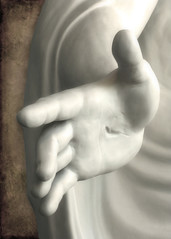
To finish our visit to the Square, we stopped in to see the Christus statue.  The physical design of this exhibit is brilliant, as you are able to walk up a spiral ramp to the viewing area.  The statue kind of pops into view and leaves quite an impression.

Bug was particularly struck by this statue, and she positioned herself about 5 feet away from the pedestal, looked up, and was positively glued for a minute.  Then she did something that really stood out to me.  I watched as she lifted her arms to 90 degree angles.  She turned her palms up, tilted her head down, and examined her hands.  First her left, then her right.  Slowly and deliberately, she looked up again at the statue.  She studied Christ's hands carefully, comparing them with hers.  Christ's hands had strange holes that her hands didn't.  It was a difference that captivated her.


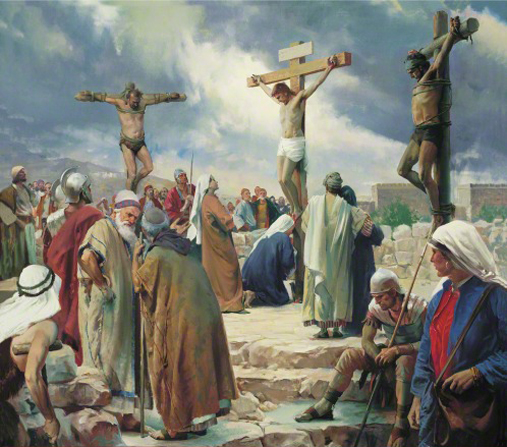
After a couple minutes, she stepped away, and we made our way back downstairs.  The downstairs portion of the exhibit displayed several large paintings depicting Christ's life and ministry.  I took Bug's hand and walked her over to one painting of Christ hanging on the cross.


"What do you notice about His hands?" I asked her.

"They're bleeding."

We talked about how people drove nails through his hands to hold him on the cross1.  We discussed the significance of Christ retaining those scars after his Resurrection to remind us of how he suffered so that we could return to God.

Bug is normally very sensitive to discussions about people suffering.  She usually withdraws from such conversations.  She worries about people who suffer and her sadness is visible in her eyes.  I saw a flash of that withdrawal for a moment at the start of our discussion.  But it was only a flash.  Then I watched as truth infiltrated her soul.  I watched the Holy Spirit reach out to her.  Right then, I saw Christ became more real than Santa Claus.  For the first time, Christ became real to her.  And with her help, once more Christ became real to me.

Bug turned to the podium in front of the painting.  "What does this say?" she asked.  I read:
he was wounded for our transgressions, he was bruised for our iniquities: the chastisement of our peace was upon him; and with his stripes we are healed. (Isaiah 53:5)
"With his wounds, we are healed." I explained to her, fighting back tears.  She wrapped her arms around my neck, and I could have lived in that moment forever.

"Daddy?"

"Yes, Bug?"  I looked her in the eye, ready for the profound truth about to come from the mouth of my babe.

"I need to go potty."

1 "Because they ran out of rope" she said. (the thieves are tied up with ropes in this painting)

Thursday, June 12, 2014

A Little Less Like Home

The past 24 hours have been an arrangement of sadness, laughter, and joy.  I have to thank the friends who helped bring in the laughter and joy.  Without their company, I might have spiraled into an all-out rage.

Two members of the Church are being called to a disciplinary council.  These councils are the formal mechanism by which members may be disfellowshipped or excommunicated from the church.

I get that the Church has the right to do this.  I understand why they are doing it.  But in the larger context of the past few weeks, it makes me very uncomfortable.  For me, this is what I see coming from the Church right now:

  1. We're meeting with Mormon Women Stand because this is how we feel proper women of the Church should behave.
  2. We don't meet with extreme groups.  If you have questions about the role of women (or other teachings of the Church), meet with your local priesthood leaders.
  3. By the way, we're likely excommunicating a few of people who have been critical of Church teachings.
So yeah, I feel real comfortable talking to my bishop now.

The thing that I find most frustrating is that it feels like the Church hasn't even attempted any real dialog on the issue.  The closest thing we've seen is Elder Oaks' talk in the most recent General Conference.  I read his talk again this morning to see if there was anything I missed.  Let me share with you all of the new things I learned from his talk-----okay I'm done.  Because he didn't teach anything new.  

Maybe I'm exceptional (I doubt that), but I already knew everything he talked about.  Reminders are great.  I won't begrudge anyone a reminder of the Church's position.  But reiterating your position is not the same as having a dialog on the topic.

For clarity's sake, let me mock up the conversation as it appears to have been had from my perspective:
Ordain Women: We believe true equality requires that women be ordained to the priesthood.
LDS Church: We disagree with your conclusion.
Ordain Women: Perhaps we should talk about this.  Here's are the assumptions and logical processes that led to our conclusion.
LDS Church: We still disagree with your conclusion.  
Ordain Women: Could you elaborate on your assumptions, or tell us where you disagree with our assumptions?
LDS Church: We continue to disagree with your conclusion.  We will now restate our conclusion.   
 Yes, there's a lot of nuance missing there.  There's a lot more going into the disciplinary councils than just pressure for dialog.  But this is the core of what bothers me about the whole affair.  I am extremely uncomfortable with the Church leadership stating its conclusion without explaining how it got to the conclusion.  Would it really be so hard to say something as simple as "We disagree with your assertion that Joseph Smith ordained Emma Smith to the priesthood--it is our understanding that the language surrounding priesthood ordinations and settings apart was not as specific as it is today.  We believe that, in modern language, Emma Smith was set apart to a position of authority."

I want to understand.  I don't even have to agree with all of the logic in order to accept the result.  I just want to see if the logic that led to the result is internally consistent.  With the information that is coming out of the Church (and by information, I mean deafening silence), I can't do that.

I keep hearing people say, "Well how do you know that they haven't prayed about and gotten an answer."  I don't.  I also don't know that they have prayed about it.  I don't know anything.  I haven't been given the chance to understand.  Everything I've heard is just a reiteration of what the current position is.  And that's precisely what bothers me.

Today, I feel a little less safe in the Church.  I feel that people like me, who want more depth and understanding--about not just what, but why and how--are less welcome.  I feel I've lost a part of the refuge that church has been for me the past six months.  Church feels less like home today, and that makes me sad.

Friday, June 6, 2014

Mormon Superiority Myths: Infidelity

I'm a sucker for click-bait, I'll admit it.  But my fascination usually stems from a curiosity regarding how badly the headline mangles reality.  So I couldn't resist when I saw the headline "You May Be Surprised How Many Born-Again Christians Use Ashley Madison."

A new survey conducted by Ashley Madison -- a dating website for people already in relationships -- sought to discover the link between religion and infidelity by asking 105,000 of its members around the world about their religious affiliation. More than 60,000 of the respondents were in the U.S.

The implication is that Born-again Christians are more likely to cheat on their partners than those from other religions because they make up 25.1% of the user base at Ashley Madison.  Don't be fooled: they have demonstrated no such thing.  Instead of demonstrating that a randomly chosen Evangelical Christian is more likely to be a user of Ashley Madison, they've actually shown that a randomly chosen Ashley Madison is most likely to be an Evangelical Christian.

Big deal.

If we take a look at the percentages of religions in the population compared to the percentages of religions in the user base, we get a different idea.  Take a look:


Religion Percentage of Population Percentage of Ashley Madison Users
Evangelist 26.3 25.10
Catholic 23.9 22.75
Protestant 18.1 22.70
Agnostic 2.4 2.00
Mormon 1.7 1.60
Muslim 0.6 1.50
Jewish 1.7 1.40
Atheist 1.6 1.40
Jehovah's Witness 0.7 0.50
Hinduism 0.4 0.30


As you can see, the percentages track pretty well.  Statistically, we would call this good agreement between the data.  A goodness of fit tests also indicates no reason to suspect that the distributions differ (p = 0.22).

What's the practical interpretation?  Effectively, all American religions (and non religions) suffer from infidelity in fairly equal proportions.  Well, at least the kind of infidelity where people are willing to pay a website to help them cheat.

So what does this all mean for Mormon culture?  Nothing really.  At most, we might think that Mormons aren't any better behaved than other religions. 

My advice: save your money and take your partner out to dinner.

http://religions.pewforum.org/affiliations
http://religions.pewforum.org/reports
http://www.huffingtonpost.com/2014/06/04/infidelity-and-religion_n_5447526.html?tm_hp_ref=mostpopular